
🏆Finalist, Belgium Startup Awards 2026·Backed by Start it @KBC Accelerator
Sagy

Platform

AI workflow agents that execute and learn.

Sagy helps teams map workflows, execute them with AI agents, and keep proven paths available for the next support issue, engineering investigation, or operational problem.

Schedule demo
HomeSee how Sagy helps teams execute and improve complex workflows.Incident Investigation AgentGather evidence across tools and surface the next action faster.Engineering MemoryPreserve decisions, fixes, and investigation paths automatically.Sagy in ActionFind the Sagy page that matches your team’s use case.

Use Cases

Start with the use case, not the label.

Start with a service investigation if needed, then move into sales and support, embedded systems, or production workflows once the right agent opportunities are clear.

Schedule demo

Services First

Investigation ServicesWork with Sagy to investigate your current issues first, then decide which workflows should become agents.

Sales & Support

Incident Investigation AgentExample use case for turning inbound issues into structured investigations.Investigator DemoExample walkthrough of a support or escalation workflow.

Embedded Systems & Devices

Firmware ReproductionExample use case for reducing setup time before embedded debugging starts.Hardware Investigation AgentExample use case for device, lab, and embedded investigation workflows.Wireless Networking AgentExample use case for networking devices and field debugging workflows.

Production & Regulated Operations

Production Line Support AgentSimple use case for troubleshooting production lines with access to procedures, support context, and prior incidents.TelecommunicationsExample use case for production networking and connected-device operations.Avionics & AerospaceExample use case for safety-critical embedded and certification-heavy workflows.Medical DevicesExample use case for regulated device investigation and documentation workflows.

Workflow Foundations

Tool IntegrationsSee the tool layer that supports Sagy use cases.Confluence AlternativeExample of how Sagy can keep workflow knowledge alive without stale wiki pages.

Learn

Practical guides for engineering investigation.

Read focused content on MTTR, root-cause workflows, customer bugs, embedded reproduction, and secure AI agents for engineering teams.

Schedule demo
Security & DeploymentReview private deployment, human approval, auditability, and access control.Blog IndexRead practical articles for engineering teams investigating complex issues.Reduce MTTRLearn how repeatable incident investigation lowers resolution time.Root-Cause WorkflowFollow a source-backed workflow for engineering root-cause analysis.Slack Jira GitHub IncidentsConnect conversations, tickets, and code changes during incidents.Customer Bug WorkflowTurn customer reports into structured engineering investigations.Incident KnowledgeSee how AI agents preserve fixes, evidence, and decisions.Embedded Bug ReproductionLearn why reproducing customer bugs can take days before debugging begins.Static Knowledge BasesSee why static docs miss the decisions engineers need during incidents.Purpose-Built AgentsUnderstand why focused agents outperform generic assistants for engineering work.

Company

Company, hiring, and policy pages.

Learn who is building Sagy, how we handle data, and where we are hiring.

Schedule demo
TeamMeet the team building Sagy for engineering organizations.CareersExplore opportunities to help build the AI investigation layer.PrivacyUnderstand how Sagy handles customer information and product data.
Home/Blog

From One AI to Many: Why the Future Belongs to Purpose-Built Agents

The future isn’t a single “company chatbot”. The future is many agents, each with a clear job, creating clarity and trust.

Wissem
WissemFounder @ sagy
January 12, 2026
5 min read
From One AI to Many: Why the Future Belongs to Purpose-Built Agents

For the past two years, most companies have experimented with AI the same way: one chatbot, connected to “everything”, answering “anything”.

At first, it feels magical.

Then reality hits.

  • Answers become vague.
  • Permissions get blurry.
  • Trust erodes.
  • And teams quietly stop using it.

The problem isn’t AI.

The problem is the idea that one agent can serve everyone.

Work Is Specialized. AI Should Be Too.

Modern organizations don’t operate as one brain.

They’re made of:

  • Engineering teams shipping code
  • HR teams managing people and policies
  • Support teams helping customers
  • Sales and Ops teams running the business

Each team:

  • Uses different tools
  • Owns different knowledge
  • Has different risks
  • Needs different answers

So why would they all share the same AI?

The future isn’t a single “company chatbot”.

The future is many agents, each with a clear job.

What an Agent Really Is (And Isn’t)

An agent is not just a prompt.

And it’s definitely not “ChatGPT with more context”.

A real agent has:

  • âś“ A clear identity (who it is, what it’s responsible for)
  • âś“ Explicit knowledge boundaries
  • âś“ Specific integrations
  • âś“ Limited, intentional capabilities
  • âś“ Defined places where it operates

An agent is software with responsibility.

Sagy Agent Builder Flow showing Identity, Knowledge, and Capabilities steps
Defining an agent's identity and boundaries before it writes a single word.

The Shift: From Generic AI to Agent Systems

This is the shift we’re seeing across the best teams:

Old Model
New Model
One chatbot
Many specialized agents
Broad access
Scoped permissions
Vague answers
Source-backed answers
Manual trust
Built-in governance
AI as a toy
AI as infrastructure

This is not about adding complexity.

It’s about aligning AI with how work actually happens.

Three Engineering Investigation Agents. One Clear Category.

Let’s make this concrete for engineering teams instead of spreading the story across every department.
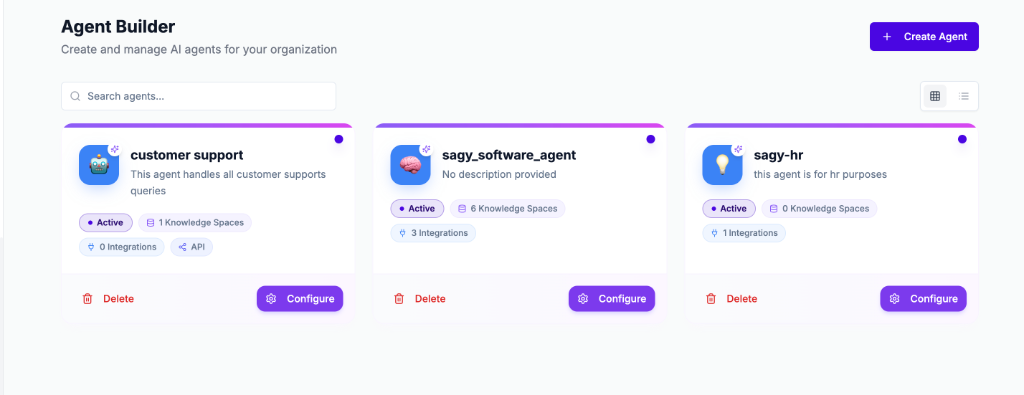
Sagy Dashboard showing specialized engineering investigation agents
Specialized agents should map to real engineering investigation workflows.

1 The Incident Investigation Agent

Purpose: Help engineers investigate production issues faster without rebuilding context from scratch.

Access

  • • Slack or Teams threads
  • • Jira tickets
  • • GitHub pull requests and commits
  • • Logs, docs, and engineering memory

What it produces

  • • Root-cause hypotheses
  • • Source-backed evidence
  • • Next actions for human validation

2 The Firmware Reproduction Agent

Purpose: Remove repetitive setup work before embedded debugging starts.

Access

  • • Firmware versions and build artifacts
  • • Serial or SSH workflows
  • • Lab procedures and historical bugs

What it produces

  • • Reproduction status
  • • Captured logs
  • • Repeatable investigation reports

3 The Engineering Memory Agent

Purpose: Turn validated investigations into reusable knowledge for the next incident.

Access

  • • Resolved incident evidence
  • • Engineering decisions
  • • Workflow feedback and validated fixes

What it produces

  • • Reusable investigation workflows
  • • Source-backed engineering memory
  • • Faster future root-cause analysis

Why This Model Works

Because clarity creates trust.

When users know:

  • What an agent knows
  • What it doesn’t know
  • Where answers come from

They stop second-guessing. They stop double-checking. They start relying on it.

That’s when AI stops being a demo, and becomes infrastructure.

Agents Need Feedback Loops, Not Just Conversations

A serious agent doesn’t just answer questions. It learns from gaps.

That’s why each agent needs its own dashboard:

  • Unanswered questions
  • Repeated topics
  • Knowledge gaps
  • Usage patterns

This turns agents into:

  • Documentation signals
  • Process improvement tools
  • Living reflections of how teams actually work

The Big Idea: AI That Respects Structure

The next generation of AI at work won’t be louder.

It won’t be more autonomous for the sake of it.

It won’t try to replace teams.

It will be:

Scoped Intentional Governed Integrated Trusted

Not one AI.

But many.

Each doing one job well.

That’s how AI becomes useful, durable, and adopted, not just impressive.

Related Sagy pages

AI Incident Investigation AgentSee the focused Sagy agent for engineering incident investigation.Slack, Jira & GitHub WorkflowFollow incidents across conversations, tickets, and code changes.
Thanks for reading.

Ready to test Sagy?

Schedule a demo for one of your high-value workflows.

Bring a real support issue, engineering investigation, or production problem. We can start by helping investigate it as a service, then map the workflow and turn what works into reusable operational knowledge and agents.

Schedule a demo
sagy

AI workflow agents for teams running complex support, engineering, and operations work.

HomeIncident AgentSlack/Jira/GitHub WorkflowFirmware Bug ReproductionHardware AgentWireless AgentTelecommunicationsAvionicsMedical DevicesEngineering MemoryConfluence AlternativeIntegrationsSecurity & DeploymentBlogTeamCareersLinkedIn Contact
Contact

© 2026 Sagy. All rights reserved.